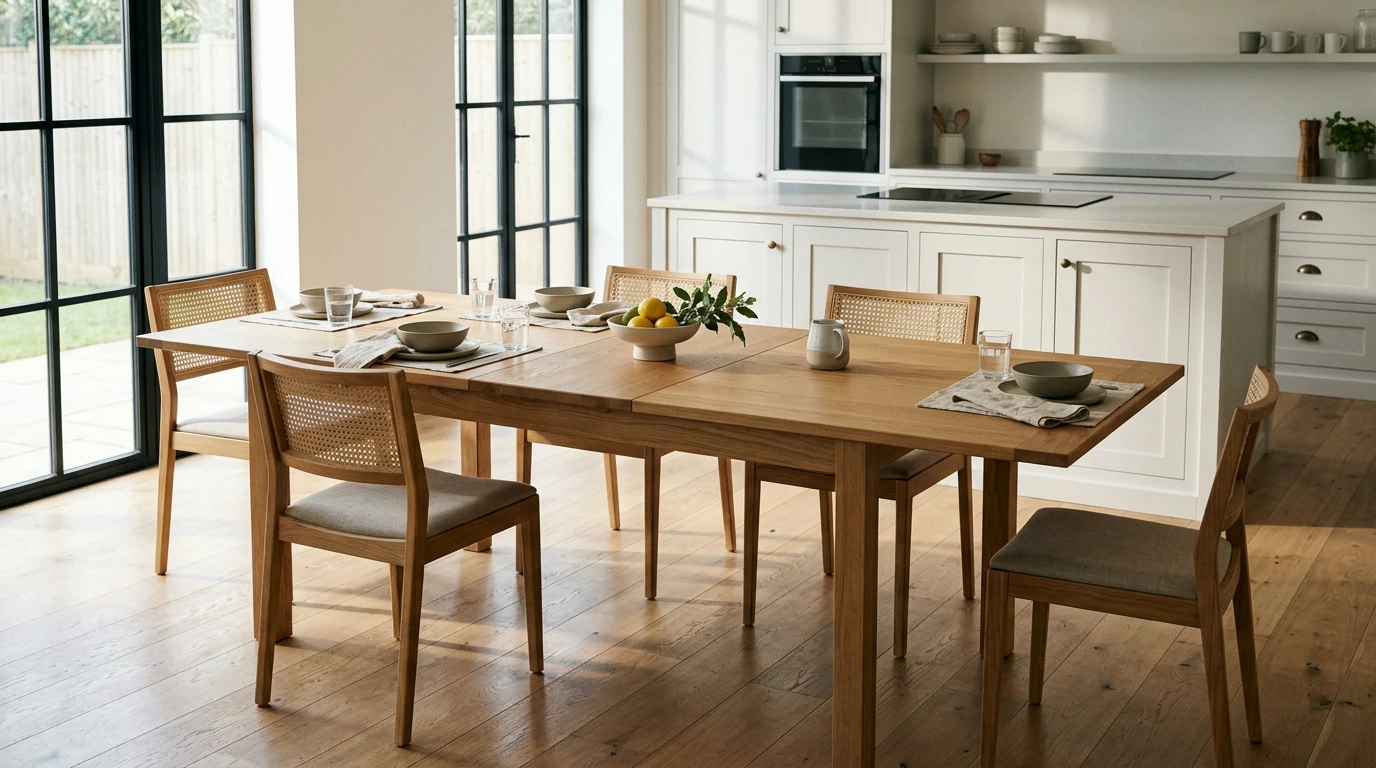
A rectangular extendable kitchen dining table makes day-to-day dining feel comfortable while keeping extra seating on standby for guests. With a straightforward shape that fits along walls or centered in a room, the extendable design helps balance space-saving practicality with the ability to host when needed. The result is a table that can stay “right-sized” most days—then expand quickly when dinners run long, family visits overlap, or homework and meal prep need to share the same surface.
Rectangular tables tend to match the geometry of most kitchens. Whether the space is a galley layout, an open-plan kitchen-dining area, or a tucked-in breakfast nook, the long, straight edges align naturally with cabinetry runs and walkways.
An extendable format also keeps circulation clearer. Instead of committing to a large table footprint every day, the tabletop grows only when the extra seats are truly needed. For daily meals, the compact configuration helps protect the “lane” between the table and counters, islands, or the fridge.
Another advantage is placement flexibility. Straight edges make it easy to slide the table closer to a wall or pair it with a banquette for casual breakfasts and weeknight dinners. And because the silhouette is familiar, chair placement and table setting stay intuitive—whether it’s cereal on a weekday or a more formal spread when company arrives.
The extension style determines how often the table gets used to its full potential. Common leaf types include removable leaves (stored separately), butterfly leaves (fold and store inside the table), and slide-out or flip-top designs that expand with guided hardware.
Built-in storage—like a butterfly leaf—can be a major convenience in smaller homes because it avoids hunting for closet space. The tradeoff is that internal leaves add weight and moving parts, so it’s worth considering whether one person can extend the table comfortably.
Pay attention to setup details that affect everyday satisfaction: how smoothly the tracks glide, whether the locking mechanism feels secure when closed, and how well the leaf aligns at the seam. Some tables show a center seam even in the compact position; that may be a non-issue for place settings, but it can matter if you serve directly from platters or prefer an uninterrupted wood grain for décor.
Comfort depends as much on the space around the table as it does on the tabletop itself. Plan clearance so chairs can slide out and people can pass behind seated diners without constant sidestepping. Also measure for both lengths: the compact “everyday” size and the fully extended size used for hosting.
| Layout factor | What to check | Why it matters |
|---|---|---|
| Clearance behind chairs | Space from table edge to wall/furniture | Allows chairs to slide out and people to walk behind seated diners |
| Compact vs. extended length | Both dimensions, not just the max | Ensures the table works for daily meals and hosting |
| Seat count reality | Chair width + leg placement | Avoids cramped seating when the leaf is in use |
| Extension access | Room to pull/sliding top | Prevents bumping into walls or islands during setup |
| Rug compatibility (if used) | Rug size for both lengths | Keeps front chair legs on the rug to reduce wobble and snagging |
Solid wood brings warmth and character, while engineered cores can improve dimensional stability when humidity swings through the seasons. The USDA’s reference on wood behavior is a helpful deep dive into how wood responds to moisture and why construction details matter over time: WOOD Handbook—Wood as an Engineering Material (USDA Forest Service).
The Rectangular Extendable Kitchen Dining Table is designed for homes that want a dedicated dining surface without committing to a permanently oversized table. The rectangular profile pairs easily with many chair styles and common kitchen layouts, while the extendable design supports both casual daily meals and larger gatherings. For current pricing and availability, visit the product page.
For shoppers who care about responsible manufacturing, reviewing broader furniture sustainability frameworks can also be useful when comparing brands and materials, such as the ANSI/BIFMA Furniture Sustainability Standard resources.
Seating depends on the compact and extended lengths, chair width, and how the legs or base affect knee space. For a practical estimate, measure the usable edge length in each configuration and test-fit your chairs with enough elbow room to eat comfortably, not just the maximum number that can squeeze in.
A butterfly leaf folds and stores inside the table, making it quicker to access without finding a storage spot. A removable leaf is a separate piece you insert when needed, which can be lighter and simpler, but requires safe, flat storage and a little more setup time.
Plan for chair pull-out space plus a walkway behind seated diners so people can pass without disruption. Always check clearance in both the closed and extended configurations, including the space needed to slide or open the top during setup.








Leave a comment